








Call us at
844.672.0637
844.672.0637
by Craig Rasmussen | Posted in Bikes, FAQs | 0 Comments
To reduce weight and improve overall performance, skilled bicycle manufacturers often choose to butt the bicycle's tubing in the frame. Butting is the process of removing extra material from where it is not needed. The manufacturer in turn leaves the frame untouched in the areas where it endures the most stress, for instance the joints, leaving the amount of material the same in order to insure long term strength and durability.
This type of internal frame butting isn't usually noticeable from the exterior, but with a trained ear you can tell which frames have been butted and which haven't. Here's a tip: use your nail to flick the top tube of your frame 2 inches from the seat tube weld, then use your nail to flick the center of the tube. If you can hear a considerable difference then you've got the ear! If it's butted then the center should have a more hollow sound then the welded joint area. Below is a diagram that shows the different variations of butting.
.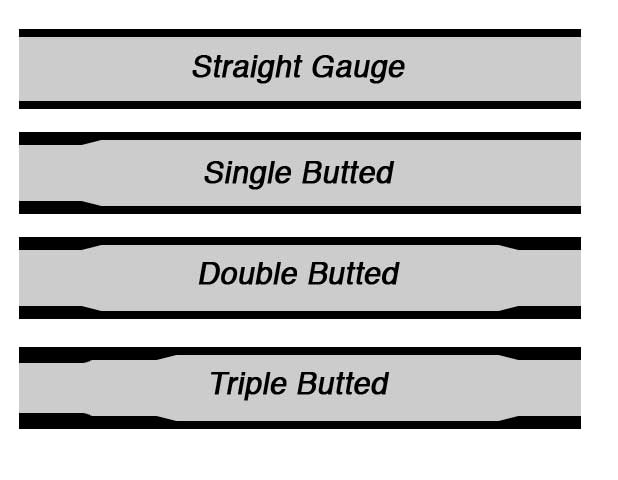
Most people will agree that butted frames make better bicycles. The difference in thinning the tube is that it provides a livelier, less stiff ride, and significantly reduces the overall weight of the bike. There are three degrees of butted frames, as shown in the picture above, with the better of the three being triple-butted. All of Tribe Bicycle Co. CRMO Series frames have been triple butted, making your bike super light. We also use 4130 Chromoly Steel, noted as one of the best materials in the industry, further adding to the strength and durability of the bicycle. Check out our CRMO Series to see the bikes and learn more!
Questions or concerns? Hit us up!
Call us: 844.672.0637
Email us: support@tribebicycles.com

 • Privacy Policy
• Terms of Use
• Return Policy
• Copyright© 2015 Tribe Bicycle Co.™.
• Privacy Policy
• Terms of Use
• Return Policy
• Copyright© 2015 Tribe Bicycle Co.™.